
By Marko Kiers on Oct 26, 2025

Should you prioritize a Product Led Growth (PLG) strategy or lean toward a Sales Led Growth (SLG) approach? In reality, there’s a broader and overarching growth strategy that deserves your focus: Customer Experience Led Growth (CX Led Growth).
Before we dive into CX Led Growth, lets explore all angles first.
What is Product Led Growth?
In B2C and B2B SaaS, a Product Led Growth (PLG) strategy aims for the product to be easily tried, purchased, onboarded, renewed, and expanded. The product should effectively sell itself by delivering a compelling experience that turns customers into advocates. Growth is driven by the strength of the product experience rather than by heavy reliance on sales or onboarding teams. The traditional paywall is lowered, reducing friction and increasing volume in the top of the funnel.
PLG is particularly effective for companies with lower Average Revenue per User (ARPU), where scale and volume are essential. In these models, the product becomes the main place where both functional and emotional value is experienced.
What is Sales Led Growth?
On the opposite end of the spectrum is Sales Led Growth (SLG). In SLG, commercial teams guide prospects, navigate complexity, align stakeholders, and shape how value is perceived. This approach fits higher-value and more complex enterprise environments where trust and coordination are required to move decisions forward.
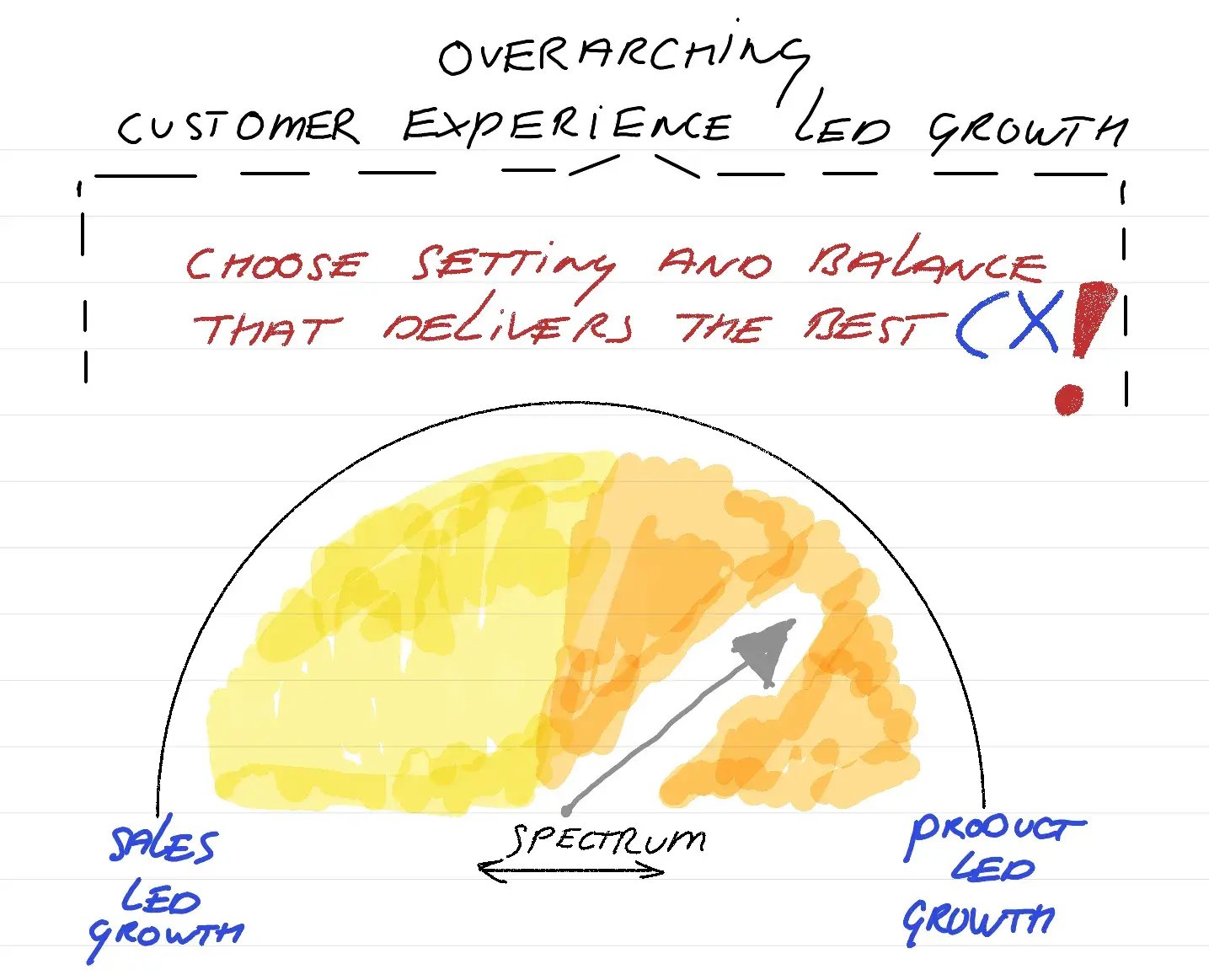
Although the two approaches are often described as opposites, most organizations shift along a spectrum depending on maturity, product complexity, and customer expectations. When a great experience requires personal engagement, it makes sense to move toward Sales Led motions. When the experience can be embedded directly in the product, the role of sales can be lighter.
Comparing Product Led and Sales Led Growth Models
Both ends of the PLG - SLG spectrum have the following main attributes:
| Attribute | Product-Led-Growth | Sales-Led-Growth |
| Driver of Sales | Product Experience | Sales teams and partner relationships |
| Primary Audience | End-users and SMB | Mid-market and Enterprise |
| Acquisition Motion | Freemium, trials, self-service | Outreach, meetings, events, collaboration |
| Quoting and Pricing | Self-serve, standardized | Proposals and negotiation |
| lnteraction Model | Low human involvement | High-touch, trust based engagement |
| Best Fit | Lower ARPU, high volume | Higher ARPU, longer buying cycles |
| Positive Effects | Scalable volume and lower CAC | Strong alignment and trust building in complex sales cycles |
Introducing Customer Experience Led Growth
No matter if your approach is Product Led Growth (PLG) or Sales Led Growth (SLG), prioritizing Customer Experience (CX) is essential for driving growth. Achieving this could mean creating an outstanding experience within the product itself, relying on your sales team to deliver that experience, or blending both approaches. The core question becomes:
How do we create a consistent and valuable experience across every stage of the customer lifecycle?
This is the foundation of Customer Experience Led Growth (CX Led Growth).
Pine and Gilmore’s The Experience Economy (1999) argued that competitive differentiation is created throughout the customer journey by delivering and staging a fantastic customer experience. Pine and Gilmore also showed vendors with a higher experience level are more profitable and more relevant to their customers. Experience is not an extra layer. It is the cumulative impression formed across every interaction a vendor has with its customers.
Another excellent example is Will Guidara’s “Unreasonable Hospitality,” a book centered around one of the world’s most celebrated restaurants that approaches the pursuit of a Michelin 3-star rating from a unique perspective. Their secret isn’t just delivering exceptional food (the product)—it’s how every team member is empowered to create memorable experiences for guests. This relentless focus on customer experience sets them apart. At its core, this is what a CX Led Growth model represents: a comprehensive approach that blends different delivery models to elevate the customer experience at every touchpoint.
With that in mind, PLG and SLG can be viewed as two expressions of the same underlying principle. The experience a customer has is shaped not only by product usability, or sales engagement. It is also shaped by the clarity of contracts, the quality of onboarding, the SOW, the handling of support issues, renewal conversations, billing transparency, and the tone of communication across teams.
Example: Atlassian
Atlassian built its success on a strong PLG foundation. As it moved further into enterprise markets and encountered more complex buying cycles, it expanded sales and partner functions to support customers more effectively. PLG remained core, but it was complemented by human involvement where the experience required it. (A great PLG reading in the Openview blog from Chrys de Vylder, a former head of Sales Strategy and Operations at Atlassian)
Customer Experience as the Integrating Frame
Customer Experience Led Growth does not replace Product Led Growth or Sales Led Growth. It aligns and balances them. In a Customer Experience Led Growth model, growth becomes a shared responsibility across the organization. Not the job of product alone. Not the job of sales alone.
A coordinated approach aligned around leaving the greatest experience in all steps of the customer journey.
How Customer-Experience-Led-Growth Connects to Commercial Excellence
The perspective of driving overall experience connects naturally with the concept of Commercial Excellence. Commercial Excellence is not simply improving sales efficiency, optimizing product experience or adjusting pricing models. It is the disciplined practice of optimizing the entire system that influences growth, profitability, and long term customer experience and value. It is holistic rather than functional. It acknowledges that growth emerges when every touchpoint contributes positively to the relationship.
Conclusion
Product Led Growth has enabled many SaaS organizations to scale effectively. Sales Led Growth remains essential where delivering value is complex and decision making is distributed. However, neither strategy alone captures how customers build confidence, commit, renew, and expand.
A Customer Experience Led Growth approach encourages organizations to view growth as the outcome of a coherent end-to-end experience. It creates balance across PLG and SLG based on customer context, organizational maturity, and market conditions. The mantra “Automate the predictable, humanize the exceptional” reinforces the idea that efficiency and human connection must be intentionally designed into the customer journey.
If your organization is trying to balance PLG and SLG while facing churn and a sub-optimal customer experience, Venturise helps align your commercial model around the customer journey and deliver a stronger, more durable experience.
With a Commercial Quick-Scan, we can quickly pinpoint where your organization falls on the spectrum and work together to create a practical action plan for growth.

The Essence of Commercial Excellence
Scaling Faster, Together: Turning Partnerships into Growth Multipliers
