By Marko Kiers on Nov 01, 2025

In fast-scaling B2B Tech and SaaS markets, growth rarely happens in isolation. Eco-System Led Growth is becoming increasingly critical. True acceleration starts when companies turn partnerships from tactical cooperations into strategic multipliers. To achieve Commercial Excellence, a clear partnership growth strategy is essential.
The most successful ecosystems operate as a partner flywheel, a continuous loop of identifying, engaging, and co-delivering with the right partners, learning from each collaboration, and expanding the joint offering over time.
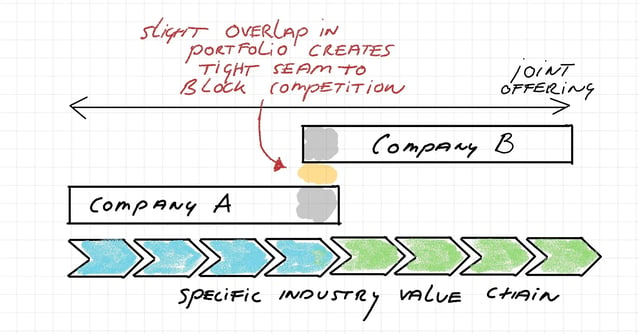
Identify partners with slight overlap
Many companies hesitate to cooperate with partners whose products partially overlap with their own. Can we trust this party? Will we hurt our own business if we reach out? However, the most effective partnerships are often those with a small but strategic overlap.
Partnerships with a slight overlap, are air and water tight. These partnerships (with strong seams at the edges) are the ones that will succeed best. Do not avoid a modest level of competition in your portfolio; it is often the foundation of a strong partnership.
From Reactive to Proactive Partnering
Partnerships often begin reactively. A company finds another vendor working within the same account, cooperation becomes necessary, and both discover they can deliver more value together. This is a good start, but proactive partnerships are where real growth begins.
To accelerate growth, companies should map the industry value chain they operate in, and identify which other players serve the same customers.
Key questions to ask are:- Which services are essential for my clients that we do not provide?
- Who delivers these services effectively?
- Where do overlaps exist that create optimal seams to block the competition?
By examining the value chain and pinpointing specific partners, you establish a clear picture of the partnership’s Ideal Customer Profile (ICP), which defines the target customers your collaboration should address.
As an example, a post purchase experience software provider in retail could map potential partners across Retail Consultancy, CRM and Service, Returns Avoidance, Re-commerce, and Payments. Each of these fulfills part of the post purchase value chain and offers natural overlap without full competition.
Taking this approach to analyzing the value chain not only informs your partnership strategy but also provides critical insight when considering potential M&A opportunities. Building relationships within the value chain can lay the groundwork for future mergers, acquisitions, or vertical integration as your ecosystem matures.
Lead your engagement with Deal Shapers
After identifying areas of overlap, the next step is to dive deeper into determining which partners to engage with and understanding how these relationships can impact deal outcomes.
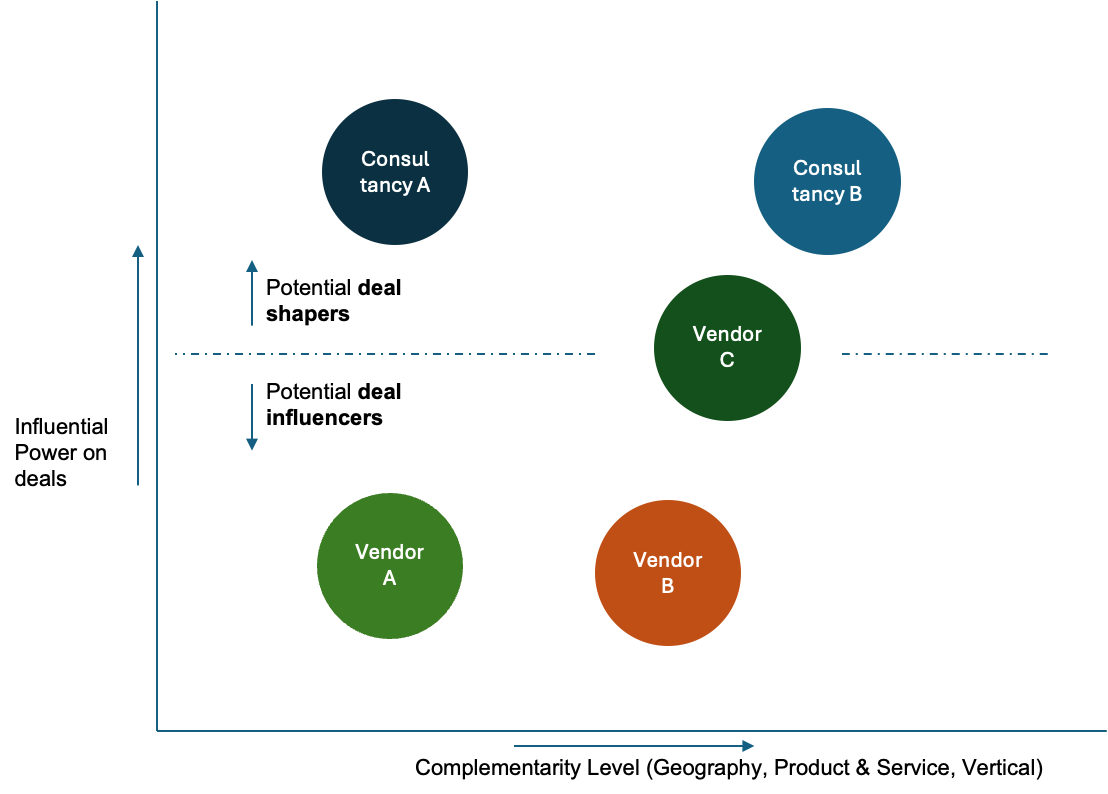
Companies can categorize potential partners as either Deal Shapers or Deal Influencers and plot them along a y-axis representing their level of influence on client decision making. By mapping the degree of complementarity in geographic coverage, products/services, and vertical markets on the x-axis a clear visualization of partnership priorities emerges.
Your primary partnership development efforts should focus on the top right area where you find Deal Shapers who offer a high degree of complementarity.
Deal Shapers
Deal shapers influence clients to change their way of working and usually operate at a strategic level. They can shape deals from scratch. They may be consultancy firms advising clients on cost and profit structures and recommending fundamental changes in Go To Market strategy, systems, or processes. Cooperating with industry specific or niche consultancy players tends to work better than with large generic firms because the overlap is more meaningful.
Deal Influencers
Deal influencers may not shape deals from scratch, but they already hold strong positions in their verticals or geographies. They can influence RFPs, bids, and customer opinions on solution choices. Mapping these influencers based on influence power and current relationship strength helps to focus partnership development effectively.
Focus your energy
Quality over quantity matters here. Attempting to partner with every possible organization rarely leads to success. Building a productive partner flywheel requires dedicated time and focus. Instead, break down the industry value chain into distinct segments, map partners according to their influence, complementarity, and relationship maturity, and then concentrate on those who offer the greatest value.
Further segmenting partners provides useful insights into where to focus your efforts, for example:
- By account focus. Strategic, Medium or Small account
- By Geographic reach: US, EMEA, ASIA or Global
- By vertical specialization: Manufacturing, Retail, Healthcare, etc.
For example, if your aim is to boost SME volume, focus on engaging partners who already excel in that segment rather than those primarily oriented toward the enterprise market.
Target and Win Deals together
Once partners have been identified and initial trust has been established, it is time to bring the partnership to life. You may already have several joint customers willing to serve as references. Initiatives can start as simply as hosting a joint webinar in which a customer shares their positive experience. Ensure that your marketing efforts are well integrated, combining intent tracking, targeted outreach, joint content, and both in-person and online events to maximize impact.
Executive engagement is essential for true partnerships. The most successful collaborations are typically initiated between CEOs and then embedded throughout the organization.
Over time, the success of these partnerships and the tangible deals they generate help build trust and strengthen collaboration, shielding against competitors.
A range of advanced tools are available to support ecosystem growth. Platforms such as Crossbeam, Partnertap, and Partnerstack enable secure data sharing, automate outreach, and uncover shared opportunities. These tools enhance existing company data with valuable ecosystem insights and provide connections with top outreach and go to market solutions, including platforms like Clay and CRM systems such as Salesforce and HubSpot, making it easy for business partners to enrich their data together.
Learn and constantly adapt
To maintain healthy partnerships, it is important to conduct regular evaluations. Assessing the Customer Experience (CX) level of your joint offering should be a top priority. (Customer Experience Led Growth also applies to your partner strategy). Consider how working together more closely on optimizing CX can create improvements. Early joint deals act as minimum viable products and deliver value, but they require ongoing attention and development to fully realize their potential.
Partnerships can face pressure during the first joint implementations. In many cases, customer onboarding proceeds less smoothly because standards and procedures have not yet been clearly defined or put into practice. While executives and sales teams often initiate cooperation, excluding technical teams in the early stages can undermine trust. Establish joint onboarding plans early in the process and ensure that commercial and technical teams are operationally aligned to enable a smooth implementation.
As soon as possible, document the most important aspects of the collaboration in a playbook by standardizing onboarding, establishing shared sales motions, and setting up joint customer service processes. Only when these elements are organized within clear processes, a partnership is ready to scale.
Expand and scale your eco-system (Ecosystem-Led Growth)
As your efforts start to build momentum and more opportunities arise, it becomes important to look further. When existing customers become advocates, they bring new energy to the partnership and help drive it to the next stage of growth. Marketing teams can leverage the momentum further by automating their outreach to clients in the joint ICP, setting up larger events and creating valuable content from specific customer success stories.
It is also essential to remain alert to shifting market conditions. Investors or shareholders might encourage mergers or acquisitions, which can quickly change the dynamics between partners. A reliable collaborator today might soon be part of a larger organization that has different interests or could even become a competitor. Staying informed about the current state and future plans of both existing and potential partners helps you respond quickly when the landscape changes.
Final conclusions for building successful partnerships in B2B organizations
- Don't avoid overlap; it creates accountability, shared ownership, and a natural barrier for competitors. The seam is where mutual value is created and defended.
- Proactive mapping beats reactive cooperation. Know your value chain and identify where to build.
- Concentrate on forming a few high-impact partnerships rather than spreading resources across numerous low-impact ones.
- Classify partners as Deal Shapers or Deal Influencers to set engagement priorities.
- Secure executive commitment early to strengthen organizational alignment.
- Make sure partnerships are embedded in the client onboarding (and service) process. Technical teams should be involved.
- Use ecosystem tools/software to share insight, automate outreach, and reveal joint opportunities.
- Document learnings, create playbooks and standardized processes.
- Your top partners can also become your most promising M&A prospects. Collaborate with your PE or VC to assess whether a successful partnership could develop into an even closer alliance.
- Scale based on trust. Be transparent not only when collaboration is possible, but even more important, when it is not.
Partnerships built this way become growth multipliers, driving both top line expansion and resilience in the face of competition. The following Ecosystem-Led Growth book can provide you with more insight: A Blueprint for Sales and Marketing Success Using the Power of Partnerships.
At Venturise, we help Investors, SaaS and Technology companies build and scale their commercial ecosystems. If you want to turn partnerships into measurable growth drivers, mapping your value chain, identifying deal shapers, and tightening the seams that block competition. Reach out to us for a partnership growth session.
Blog picture: iphone (cropped); concert of DeWolff; TivoliVredenburg

Why Customer Experience Should Be Your Competitive Advantage

Rethinking the Hunter and Farmer Divide in Sales